Iron Nutrient Deficiency in Plants
Iron (Fe) is an essential micronutrient that plays a critical role in photosynthesis, energy production, and plant metabolism. Absorbed as Fe2+ and Fe3+ ions, iron is key to chlorophyll formation and the plant’s ability to convert sunlight into energy.
Iron deficiency can quickly reduce plant growth, limit crop development, and increase susceptibility to stress if not corrected early.
What Does Iron Do in Plants?
Iron is fundamental to several vital plant processes, particularly those linked to energy production and growth. Key roles of iron include:
- Supporting photosynthesis and chlorophyll production
- Enabling efficient carbon capture and energy transfer
- Promoting healthy green leaf area and active cell function
- Aiding the movement of sugars and nutrients throughout the plant
- Activating enzymes involved in growth and plant defence
Iron also plays an important role in the plant–soil interaction, helping stimulate beneficial microbial activity around the root zone and supporting natural resistance to disease.
What Causes Iron Deficiency in Plants?
Iron deficiency is rarely due to a lack of iron in the soil. Instead, it is typically caused by conditions that limit its availability or uptake.
Common causes include:
- Alkaline or high pH soils, where iron becomes unavailable to plants
- Cold and wet soil conditions that reduce root activity
- Soil compaction, restricting root growth and nutrient uptake
- Poor root health or limited root development
These factors can prevent plants from accessing iron, even when it is present in sufficient quantities.
Some plant species are also more susceptible to iron deficiency than others. Crops with a high physiological demand for iron, such as legumes, require sufficient iron to support key processes including nitrogen fixation. Other species, such as blueberries, are naturally adapted to acidic soils and can quickly develop iron deficiency symptoms when grown in alkaline conditions where iron availability is reduced.
Iron Deficiency Symptoms in Plants
Iron deficiency primarily affects young leaves and growing points, as iron is not easily redistributed within the plant.
Typical symptoms include:
- Interveinal chlorosis on young leaves, where veins remain green and surrounding tissue turns yellow
- Severe yellowing that can lead to almost white leaf tissue in advanced cases
- Reduced chlorophyll levels and poor leaf development
- Slower growth and reduced plant vigour
Iron deficiency can sometimes be confused with magnesium deficiency, but the key difference is that iron affects new leaves first, while magnesium affects older leaves.
Visual Signs of Iron Deficiency
Iron deficiency is easily identified by its distinctive appearance in new growth:
- Bright yellow or pale leaves with clearly defined green veins
- Symptoms concentrated at the top of the plant or new shoots
- Poor canopy development and uneven growth
Early identification is important to prevent long-term impacts on crop performance.
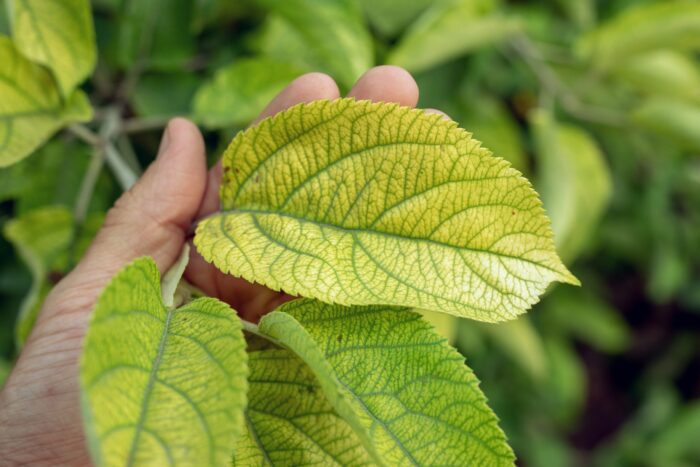 Interveinal chlorosis caused by iron deficiency.
Impact of Iron Deficiency on Crop Performance
Iron is essential for energy production in plants, meaning deficiency can significantly reduce growth and yield.
Low iron levels may result in:
- Reduced photosynthetic efficiency and energy production
- Slower growth rates and poor crop establishment
- Reduced sugar movement and limited fruit development
- Increased susceptibility to stress, disease, and infection
- Lower overall yield and crop quality
Without sufficient iron, plants struggle to convert sunlight into usable energy, directly affecting productivity.
How to Prevent and Correct Iron Deficiency
Effective iron management focuses on improving availability and supporting plant uptake.
Check Soil Conditions
Monitor soil pH and structure, as alkaline or compacted soils can limit iron availability.
Improve Root Development
Encourage strong root systems through good soil management to maximise nutrient uptake.
Address Soil Constraints
Where possible, correct compaction and drainage issues that restrict root function.
Apply Foliar Iron Treatments
Foliar feeding is one of the most effective ways to correct iron deficiency quickly, particularly during early growth stages or periods of stress.
Monitor Crops Regularly
Early detection of symptoms allows for rapid correction before yield is affected.
Supporting Crop Performance with Iron Nutrition
Maintaining adequate iron levels is essential for efficient photosynthesis, strong growth, and overall plant health. By combining good soil management with targeted foliar nutrition, growers can ensure crops receive sufficient iron throughout key growth stages.
OMEX offers a range of iron fertilisers to support different crop and soil conditions. FeN Feed, a concentrated suspension containing iron EDTA chelate and nitrogen, is designed for the prevention and rapid correction of iron deficiency, while Feomex, a fully soluble Fe EDDHA formulation, is particularly effective in alkaline soils where iron availability is limited.
Using the right iron source at the right time helps restore chlorophyll levels, improve plant energy production, and maintain crop performance under challenging growing conditions.
Related Products
FeN Feed
FeN Feed is a concentrated suspension fertilizer containing iron EDTA chelate and nitrogen, designed to prevent and correct iron deficiency
Feomex
Feomex is a fully soluble powder formulation of Fe EDDHA containing 6% iron
Related News
Cost Effective Nutrition
January 24, 2024
Take a look inside our lab…
April 11, 2024